
Wastewater Treatment
Centralized
← Increasing Level of Treatment
Decentralized
- Septic Tank with soil drain field
- Aerated Reactors with soil field
- Advanced Treatment Units for Sub-surface and/or direct discharge
Why Advanced Onsite Treatment?
Water scarcity, groundwater protection, coastal nutrient sensitivity, and aging onsite systems
What regulators and communities are managing
- Nutrient impacts (N and P) to groundwater and surface waters
- Drought resilience and supply diversification
- Failing or undersized drain fields; limited setbacks and shallow groundwater
- Need for verified performance and reliable O&M
- Pressure to capture value from wastewater (reuse) rather than discharge
Enhanced treatment (ET) expectations
- Objective: BOD/TSS <10 mg/L and N removal target <10 mg-N/L (ultimate goal)
- Minimum requirement: TN reduced ≥50% and ≤30 mg-N/L; BOD/TSS ≤30 mg/L
- ET required in sandy soils with rapid percolation (<5 min/in) and for large systems
- Pathogen reduction required when separation to groundwater/streams is limited
NextGen platform: treatment, nutrient polishing, disinfection, telemetry
Modular stack for homes, clustered systems, and building-scale flows
NextGen/IMET Biological Module
- NextGen Septic/IMET Module (Facultative soil bacteria generator, FBG)
- High-surface-area biomedia (biofilm)
- Reduces organics (BOD/TSS) in-tank
HydraSorb NP Polishing Module
- Nitrate + phosphate removal media
- Targets nutrient-sensitive watersheds
- Supports "One Water" reuse quality
Optional UVC Disinfection
- Solid-state UVC option
- Pathogen risk reduction before dispersal/reuse
- Helpful for reduced setback scenarios
Wireless Telemetry & Alarms
- Cellular or satellite monitoring kits
- Owner + service provider alerts (SMS)
- Supports O&M compliance and uptime
NextGen Septic/IMET Module
(Side Wall)
Top View and Side View of module
- Used in all NextGen Septic Treatment systems
- Uses active biofilms on the proprietary biomedia to treat the wastewater
- Module operates by having air from the external blower (only moving part) to rise through the biomedia thereby moving water in the tank to flow upwards from the bottom to the top of the module
- The movement of water upwards together with air generates a recirculation pattern inside the tank that mixes the tank
- The module also provides facultative bacteria from the biofilms that slough-off the biomedia together with dissolved oxygen
- The rising air bubbles through the packed biomedia bed breaks the bubbles into smaller and smaller bubbles that increases surface area and oxygen transfer into the water
- Does not generate any sludge as in suspended culture systems
NextGen Septic Treatment Systems
NextGen Septic uses the NextGen Septic/IMET module to treat wastewater that meets NSF 40 and 245 standards.
All of these treatment systems use the NextGen Septic/IMET module to treat the wastewater. Stand alone module that is installed in existing septic tank (remediation offer) or in new septic tank for new construction
Operates by air from an external blower that flows down. The pipe and air bubbles rise upwards through the Biomedia, entraining surrounding water with it from the bottom to the top of the module. The entrained water, flowing upwards with the air bubbles gets oxygenated and treated by the active biofilms on the surface of the biomedia.
On-Site Remediation Systems
Meets NSF 40 Standards; Single Plastic or Concrete tank
Meets NSF 245 Standards; Plastic or Concrete tank; One, Two or Three Tanks
Meets NSF 350 Standards; Plastic or Concrete tank; One or Two Tanks
New Construction
Meets NSF 40 Standards; Single Plastic or Concrete tank
Meets NSF 245 Standards; Plastic or Concrete tank; Two or Three Tanks
Meets NSF 350 Standards; Plastic or Concrete tank; Two Tanks
Remediation Systems – Drain Field Clogged
Over time, solid waste, grease, or sludge from the septic tank can escape into the drain field if the tank isn't pumped regularly (every 1-2 years). These materials clog the soil pores, preventing wastewater from percolating properly.
Example: Cooking oils or non-flushable items (e.g., wipes, sanitary products) can build up and block the drain field pipes or soil.
Retrofit Value: Improve Effluent Quality + Extend Field Life
Target use-case: biomat-related clogging (not root intrusion, broken pipes, or physical sealing)
What the retrofit does
- Introduces and retains facultative soil bacteria to better mineralize organics
- Reduces BOD/TSS loading to the dispersal field (less biomat formation)
- Supports biomat biodegradation and recovery of percolation over time
- Avoids full excavation in many biomat-driven failures (site dependent)
When it will NOT "resurrect" a field
- Broken or collapsed pipes / poor hydraulics
- Root intrusion that physically blocks or breaks distribution
- Surface sealing or physical clogging unrelated to biomat
- Site constraints requiring complete redesign (setbacks, groundwater, soils)
Why this matters
- High replacement costs and constrained lots
- Sensitive receiving waters and groundwater basins
- Local programs emphasize verified treatment + O&M
- Upgrades can be paired with reuse strategies
ATS 40 Treatment System
- Single NextGen Septic/IMET module in Tank
- Can be scaled up for 500 – 1500 GPD
- Can be retrofitted into existing tank or supplied in either poly or concrete tank
- Certified to meet NSF 40 standards
- Generates no sludge to be disposed
- Only moving part is the external blower
- Can be provided with Telemetry for alarm notification
Treatment Flow
ATS 245 Treatment System
- Single NextGen Septic/IMET module in Tank
- Can be scaled up for 500 – 1500 GPD
- Can be retrofitted into existing tank or supplied in either poly or concrete tank. Single or multiple tanks
- Certified to meet NSF 245 standards
- Generates no sludge to be disposed
- Only moving part is the external blower
- Can be provided with Telemetry for alarm notification
Treatment Flow
ATS 350 Treatment System
- Single NextGen Septic/IMET module in Tank
- Can be scaled up for 500 – 1500 GPD
- Can be retrofitted into existing tank or supplied in either poly or concrete, single or multiple tanks
- Treats the wastewater to NSF 350 standards
- Generates no sludge to be disposed
- Only moving part is the external blower
- Can be provided with Telemetry for alarm notification
Treatment Flow
Zero Liquid Discharge (ZLD)
ATS 350 effluent is further treated using a Reverse Osmosis membrane and UV disinfection before being pumped to the ZLD system
The ZLD system disperses the potable water from the Reverse Osmosis membrane into the ambient air in the form of 30 micron droplets that rapidly evaporate even at 90% relative humidity
The Zero Liquid Discharge Treatment System does not discharge water and does not require costly soil drain fields or land use not suited to accommodate a suitable drain field
ZLD Process Flow
Scale-up: from single-family to buildings and campuses
Parallel modular treatment trains + polishing + disinfection + telemetry
How we scale
- Modular trains sized by flow: stack modules in parallel for higher capacity
- Cluster designs: multi-building, multifamily, hospitality, institutional
- Reuse integration: purple-pipe distribution + storage, where permitted
- Remote monitoring for alarms, maintenance, and compliance reporting
Sizing concept
"Large System" Trigger
- Counties identify "large systems" as those serving >5 dwelling units or generating ≥2,500 gpd
- County generally assumes jurisdiction for 2,500–10,000 gpd; >10,000 gpd
- NextGen modular scale-up is designed for this stepped regulatory landscape
Greenhouse Gas Reductions
Conservative, transparent method using public emission factors
Method (methane from septic baseline)
- Baseline CH₄ EF: 10.7 g/person/day (CA inventory method)
- GWP100 for biogenic CH₄: 27 (AR6; 100-year)
- Estimate baseline CH₄ from occupancy, then apply reduction scenarios
- ATS 245 shifts more treatment to aerated/facultative conditions → potential CH₄ reduction
- Note: N₂O impacts are site- and process-dependent; quantify where monitoring is available
Illustrative reductions
Typical home (≈4 people):
Baseline CH₄ ≈ 15.6 kg/yr
Baseline CO₂e ≈ 0.42 t/yr
Scenario: methane reduced by…
50% → ≈ 0.21 tCO₂e/yr avoided
80% → ≈ 0.34 tCO₂e/yr avoided
Scale-up example:
100 occupants → ~25× a home
→ ≈ 5.3 to 8.4 tCO₂e/yr avoided
LEED impact: Water Reuse + Efficiency credits (project-dependent)
ATS 245 supports strategies that commonly earn points under LEED v4.1
Credits/paths most often supported by onsite reuse
Typical point ranges vary by LEED system (e.g., Indoor up to ~6; Outdoor up to ~2; Cooling/process up to ~2)
"LEED Points"
- LEED points vary by rating system (BD+C, ID+C, O+M), building type, and scope
- We position ATS 245 as an enabler for water budgets and alternative water sources
- We provide documentation: water balance assumptions, monitoring plan, and O&M
- We include a LEED-ready narrative + MEP reuse integration concept
Water Recycle and Reuse in US
Onsite treatment can turn a liability (wastewater) into a resource (non-potable supply)
California's recycled water supply goals
- The U.S. water recycle and reuse market is expected to grow from $6.9 billion in 2024 to over $15 billion by 2034.
- The industry is shifting from 8% to 80% in specific water reuse projects to secure future water supplies.
- Some regions aim to boost overall municipal recycling rates to 30% by 2030 and up to 60% by 2050.
Recycled water targets
Key U.S. recycled wastewater goals include increasing municipal reuse by 61% by 2026 and achieving a 50% national recycling rate by 2030, supported by a $11 billion market investment. Specific regional targets include California increasing recycled water use by ~9% by 2030 and doubling it by 2040.
Where onsite treated water can be reused (buildings)
- Toilet/urinal flushing, irrigation, cooling tower makeup, process water (site + code dependent)
- Reduce potable demand and improve resilience during drought restrictions
- Telemetry supports uptime, alarms, and service response—critical for reuse operations
NextGen Community Septic
Redefining Decentralized Treatment
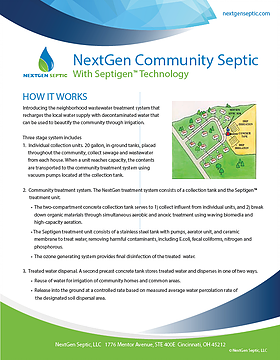
NextGen Septic for Communities
Too many communities are facing impossible cost hurdles in order to provide clean, safe solutions for treating wastewater. That's why we designed NextGen Community Septic. The scalable, low-maintenance design offers builders and homeowners the latest in community decentralized water treatment technology all while maximizing buildable land plots.
Download our community system sheet to find out if our system is right for your next project.
READ MORE