
Technical Overview
Suspended Culture vs NextGen Septic/IMET’s Biofilms
Immobilized systems naturally support:
- Stratified redox zones
- Aerobic outer layer and anoxic inner layer
- Anaerobic micro-niches
- Coexistence of slow growers: Nitrifiers, Denitrifiers, and Methanotrophs
- Lower sensitivity to toxicity
- Biofilm matrix adsorbs and dilutes toxins
Immobilized biofilm (attached growth on media in NextGen Septic/IMET Module)
Biofilm system are resistant to both low and high Food/Microorganism (F/M) ratios
| Aspect | Suspended Growth | Immobilized Biofilms |
|---|---|---|
| Sludge Retention Time (SRT) Dependence | Directly tied to Hydraulic Retention Time (HRT) | Decoupled from Hydraulic Retention Time (HRT) |
| Washout Risk | High at low HRT | Essentially zero |
| Need for Operator Control | High | Can be operated by programmable controller |
| Biomass Concentration | Limited (Maximum of 2,500 – 3,000 mg/L) | Ver High (> 12,000 mg/L) |
Immobilized cultures deliver:
✓ Stable performance across wide F/M range
✓ Faster recovery after upsets
✓ Lower sludge production
✓ Less operator attention
✓ Robust nitrogen removal under variable loading
✓ Compatibility with low-energy aeration (nanobubbles, passive oxygenation)
Nanobubbles (Ultrafine Bubbles)
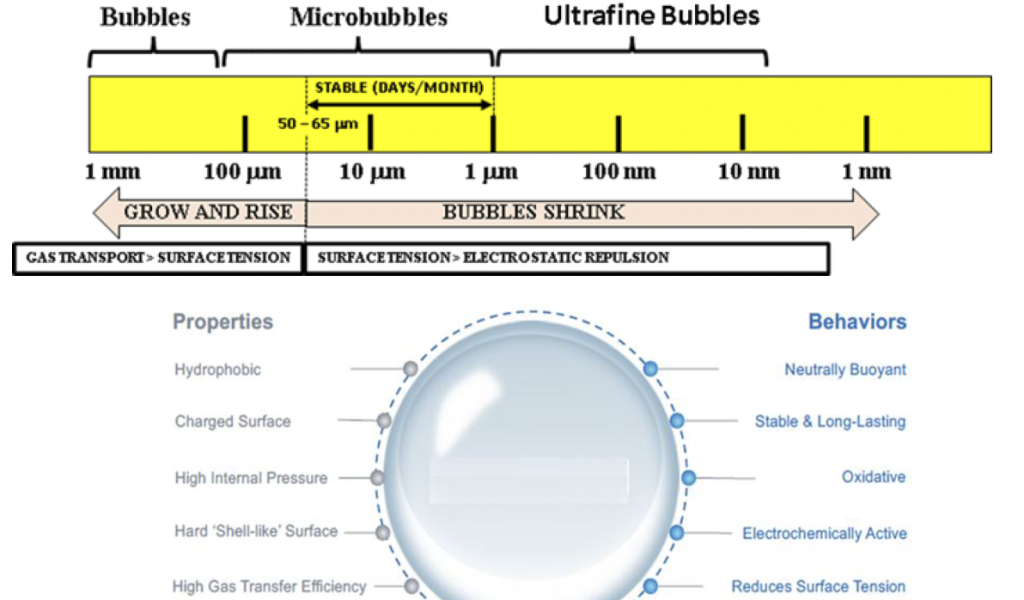
Aeration of Wastewater
- Lower cost of treatment ($/m3)
- Lower CAPEX and O&M Costs
- More treatment capacity
- Better water quality
Scale-up: from single-family to buildings and campuses
Parallel modular treatment trains + polishing + disinfection + telemetry
How we scale
- Modular trains sized by flow: stack modules in parallel for higher capacity
- Cluster designs: multi-building, multifamily, hospitality, in sstitutional
- Reuse integration: purple-pipe distribution + storage, where permitted
- Remote monitoring for alarms, maintenance, and compliance reporting
Sizing concept
| Single-family | ≈ 300–800 gpd |
| Multifamily / small commercial | ≈ 2,500–10,000 gpd |
| Buildings / campuses | ≈ 10,000–50,000+ gpd |
“Large System” Trigger
- Counties identify “large systems” as those serving >5 dwelling units or generating ≥2,500 gpd
- County generally assumes jurisdiction for 2,500–10,000 gpd; >10,000 gpd
- NextGen modular scale-up is designed for this stepped regulatory landscape
Greenhouse Gas Reductions
Conservative, transparent method using public emission factors
Method (methane from septic baseline)
- Baseline CH₄ EF: 10.7 g/person/day (CA inventory method)
- GWP100 for biogenic CH₄: 27 (AR6; 100-year)
- Estimate baseline CH₄ from occupancy, then apply reduction scenarios
- ATS 245 shifts more treatment to aerated/facultative conditions → potential CH₄ reduction
- Note: N₂O impacts are site- and process-dependent; quantify where monitoring is available
Illustrative reductions
Typical home (≈4 people):
Baseline CH₄ ≈ 15.6 kg/yr
Baseline CO₂e ≈ 0.42 t/yr
Scenario: methane reduced by…
- 50% → ≈ 0.21 tCO₂e/yr avoided
- 80% → ≈ 0.34 tCO₂e/yr avoided
Scale-up example:
- 100 occupants → ~25× a home → ≈ 5.3 to 8.4 tCO₂e/yr avoided
LEED impact: Water Reuse + Efficiency credits (project-dependent)
<>ATS 245 supports strategies that commonly earn points under LEED v4.1Credits/paths most often supported by onsite reuse
- Indoor Water Use Reduction (non-potable supply for fixtures lowers potable demand)
- Outdoor Water Use Reduction (irrigation with non-potable water where allowed)
- Cooling Tower & Process Water Use (recycled/non-potable makeup water pathways)
- Integrative Process / Water budget analysis (early-stage reuse feasibility)
- Innovation pathways when a robust reuse strategy is documented
- Typical point ranges vary by LEED system (e.g., Indoor up to ~6; Outdoor up to ~2; Cooling/process up to ~2)
“LEED Points”
- LEED points vary by rating system (BD+C, ID+C, O+M), building type, and scope
- We position ATS 245 as an enabler for water budgets and alternative water sources
- We provide documentation: water balance assumptions, monitoring plan, and O&M
- We include a LEED-ready narrative + MEP reuse integration concept